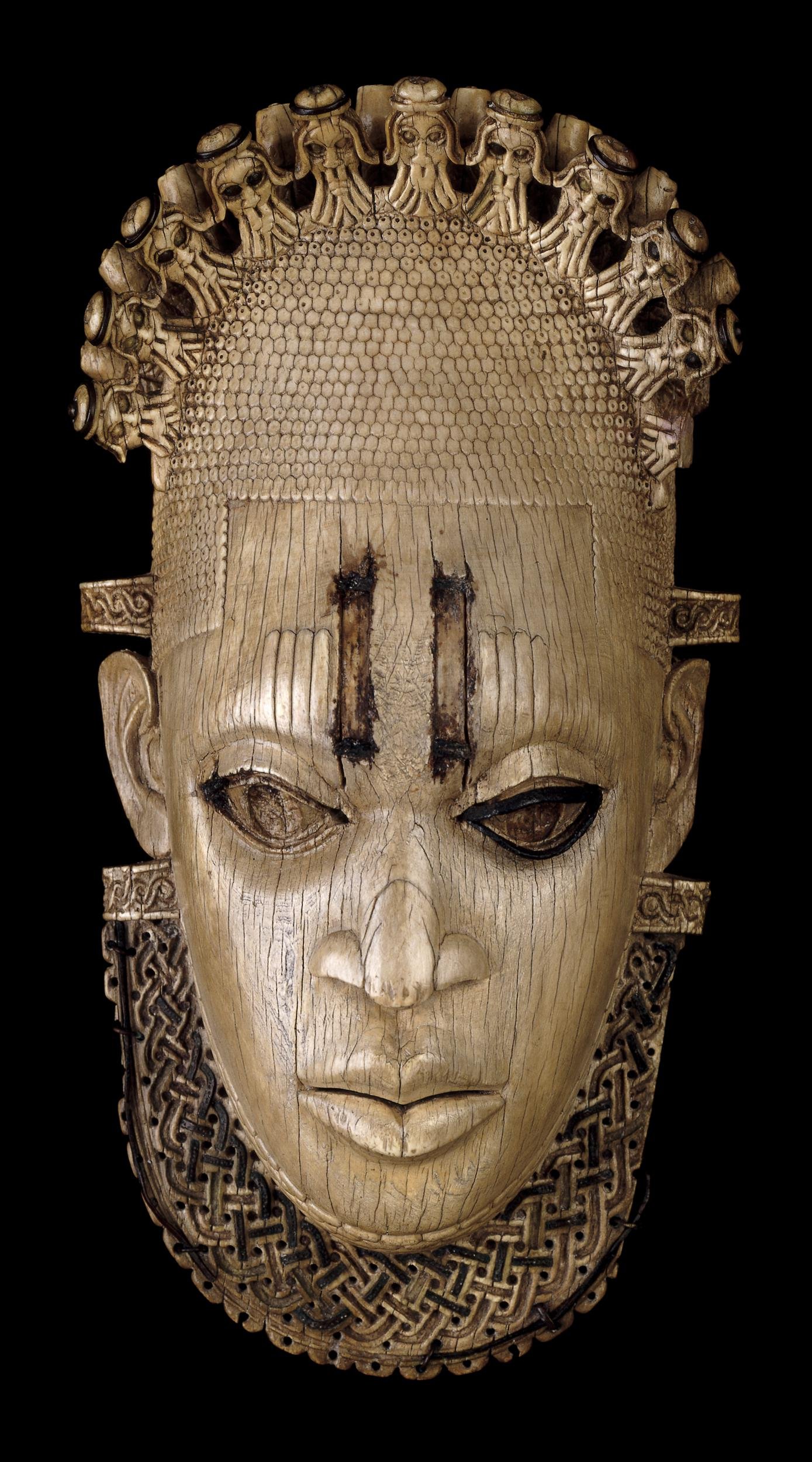
The Most Famous African Mask: The Iyoba of Benin
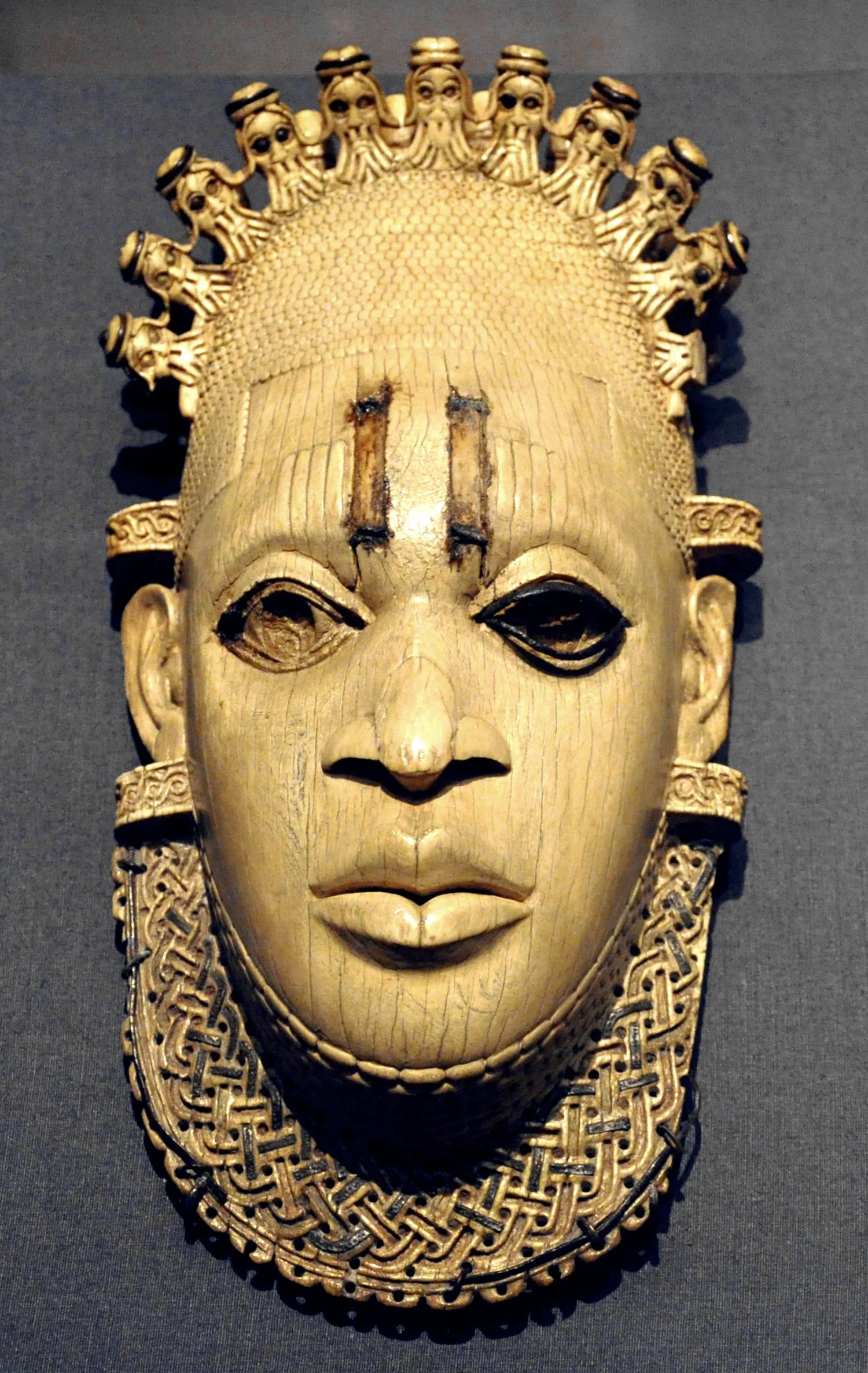
Mask of Iyoba Idia of Benin, British Museum
Source: Wikipedia Commons
Title: Ivory Mask of the Iyoba of Benin
Artist: unknown but probably a master carver from the Igbesanmwan
Date Created: early16th century CE possibly c. 1520s
Medium: ivory, inlays of iron
Size: 24.5 cm (height), 12.5 cm (width) (This is the measurements from the British Museum, the others are similar)
Art Period: Early Benin
Current Location: The British Museum and the Metropolitan Museum of Art
Quickies:
Taken during the punitive expedition in 1897 by the British Empire
There are three masks of the Iyoba (Queen Mother) in public museums and two in private collections
The current locations of the four masks are the Metropolitan Museum of Art in New York City, the British Museum in London, the Seattle Art Museum, Linden Museum in Stuttgart/Oba in Nigeria, and the heirs of Harry Galway.
The masks are part of the Benin Bronzes, which are thousands of artworks that were in the royal palace in Benin City. The Benin Bronzes can be bronze, ivory, wood, leather, or other metals. It’s estimated that about 10,000 objects comprise the Benin Bronzes.
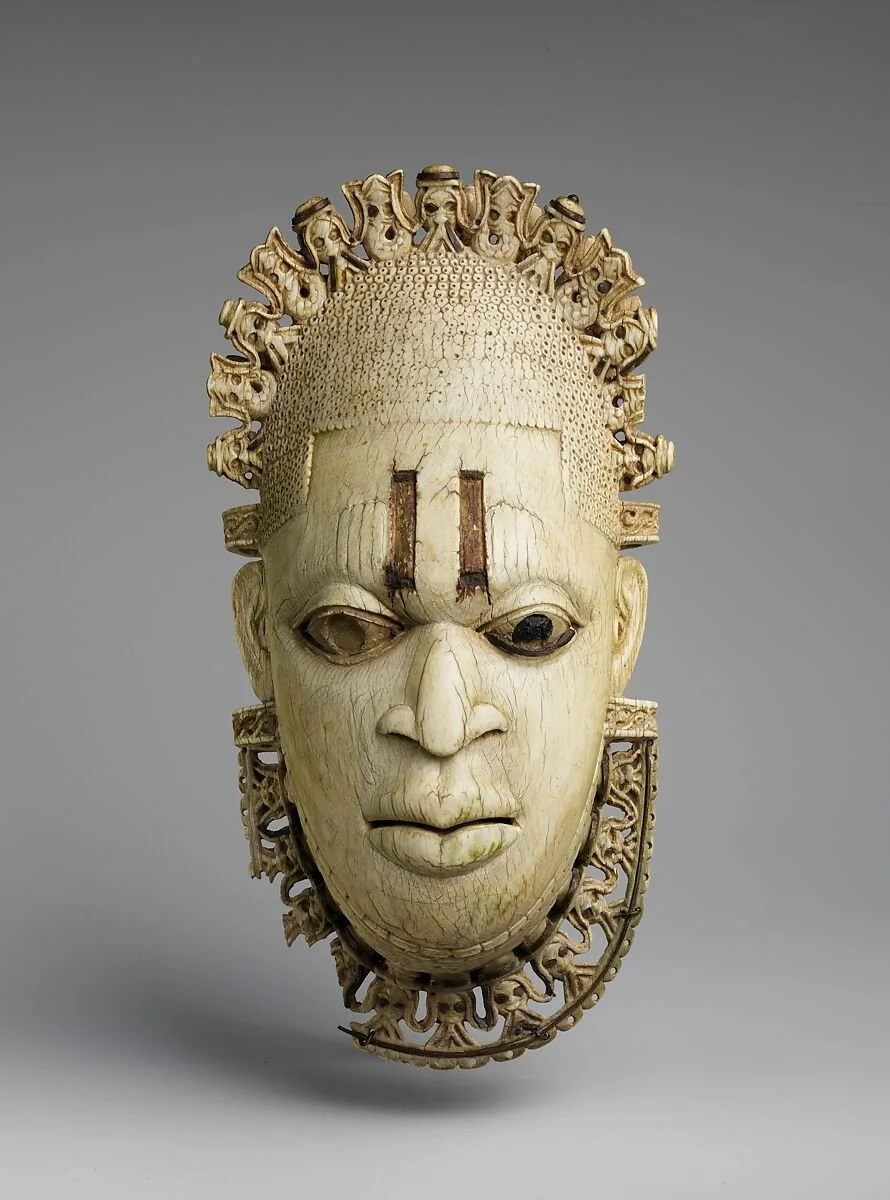
The ivory mask of Iyoba Idia
Source: The Metropolitan Museum of Art
Benin Mask Introduction
The mask is a miniature portrait of the first Iyoba, or Queen Mother, of the Benin Empire. The Benin Empire was ruled by an Oba, or King, named Esigie in the 16th century. Esigie ruled from 1504 to 1550 CE. Esigie opened his Kingdom to trading with the Portuguese. They traded pepper, ivory, textiles, coral beads, brass, copper, cowrie shells and slaves. The Oba declared his mother the Iyoba, or Queen Mother, due to her political and mystical advice during his war with the Igala Kingdom.
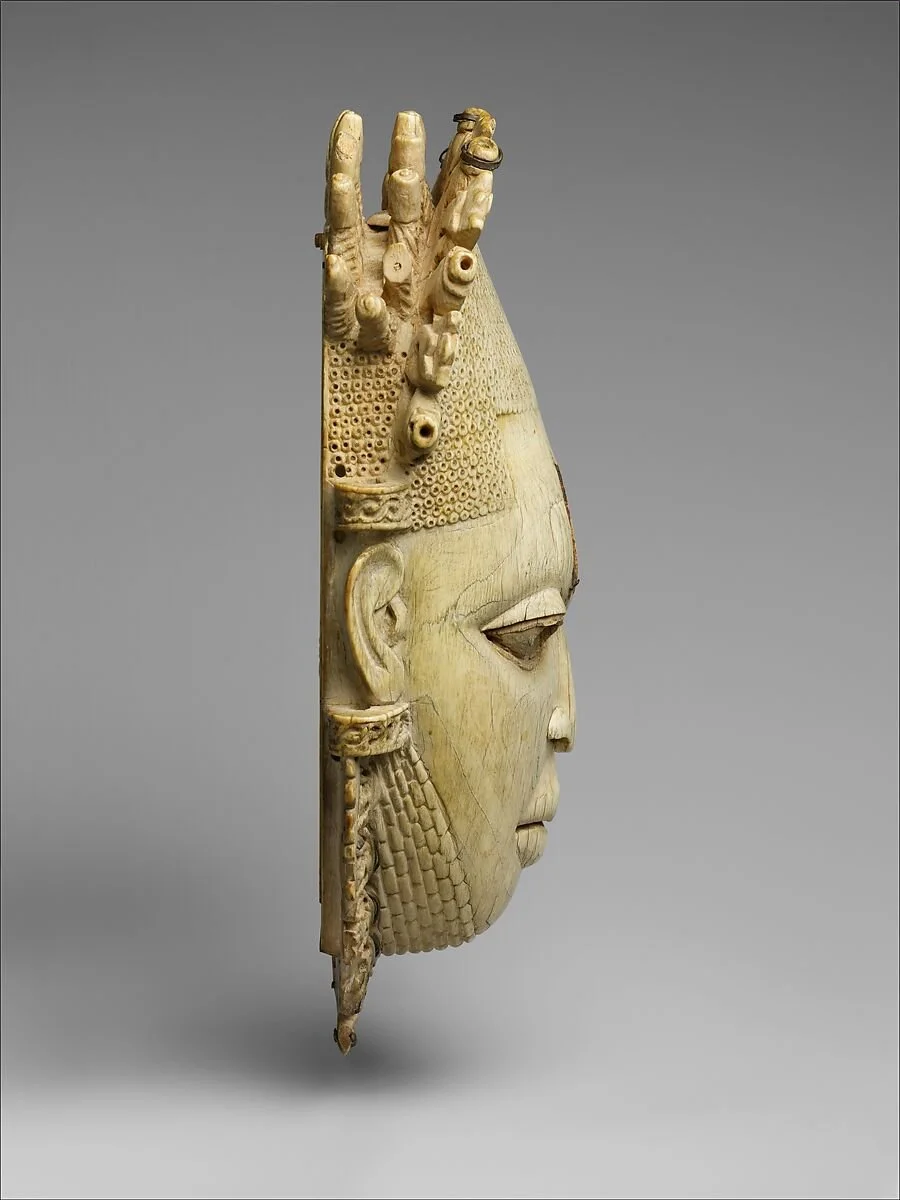
Mask Side
Source: Metropolitan Museum of Art
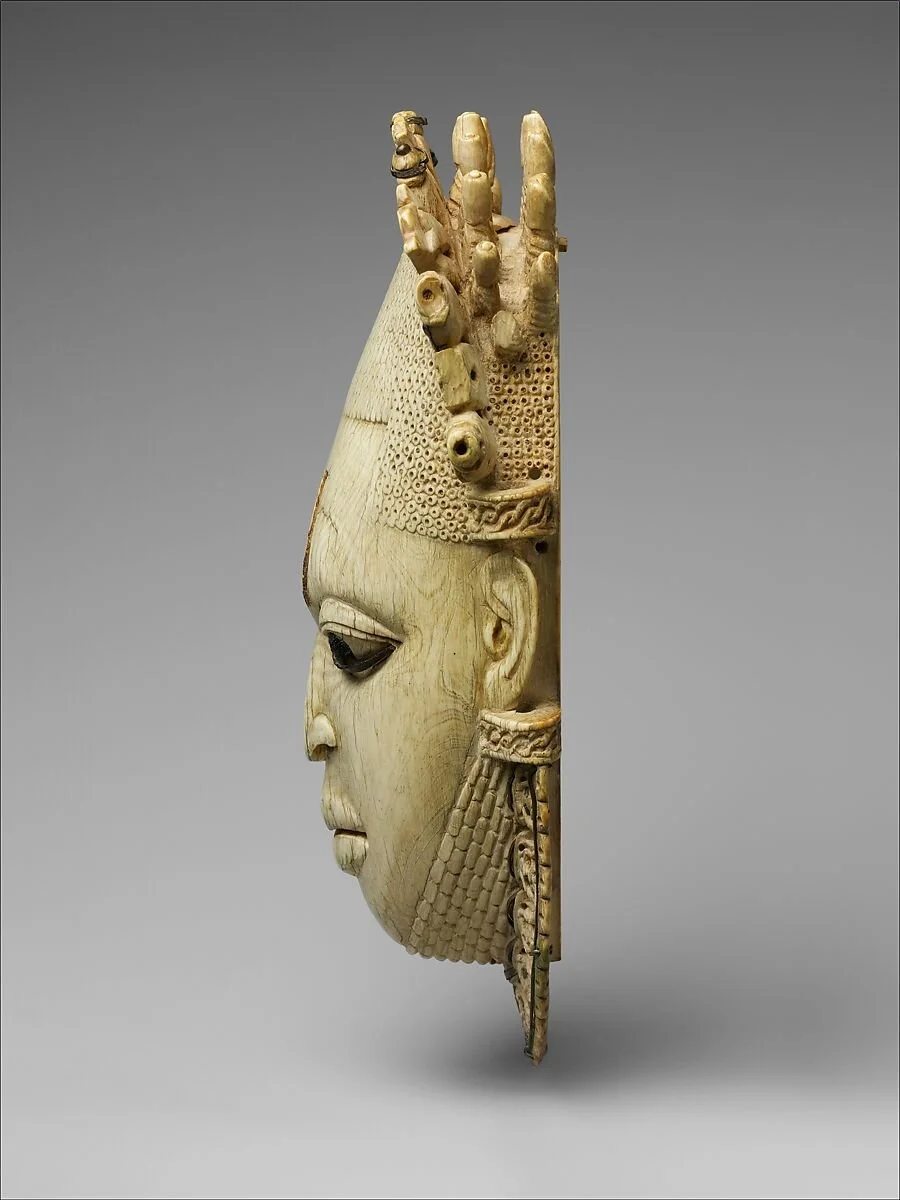
Mask Side
Source: Metropolitan Museum of Art
Why Is This Mask So Important?
The imagery of women in Benin Art during this time was rare, although the first Iyoba is certainly a remarkable figure. Most likely, the Oba commissioned the masks from a master ivory carver from the Igbesanmwan, or the guild of ivory and wood carvers that mostly worked for him. It is thought that they are carved freehand, showcasing the talent that the Igbesanmwan held.
All the masks are long, carved with thin lines. Ivory was considered special and was used to denote power and royalty. With the entrance of Europeans to the African continent, ivory became even more important to denote power due to the European want, and it became the main trading item adding to the Oba’s wealth.
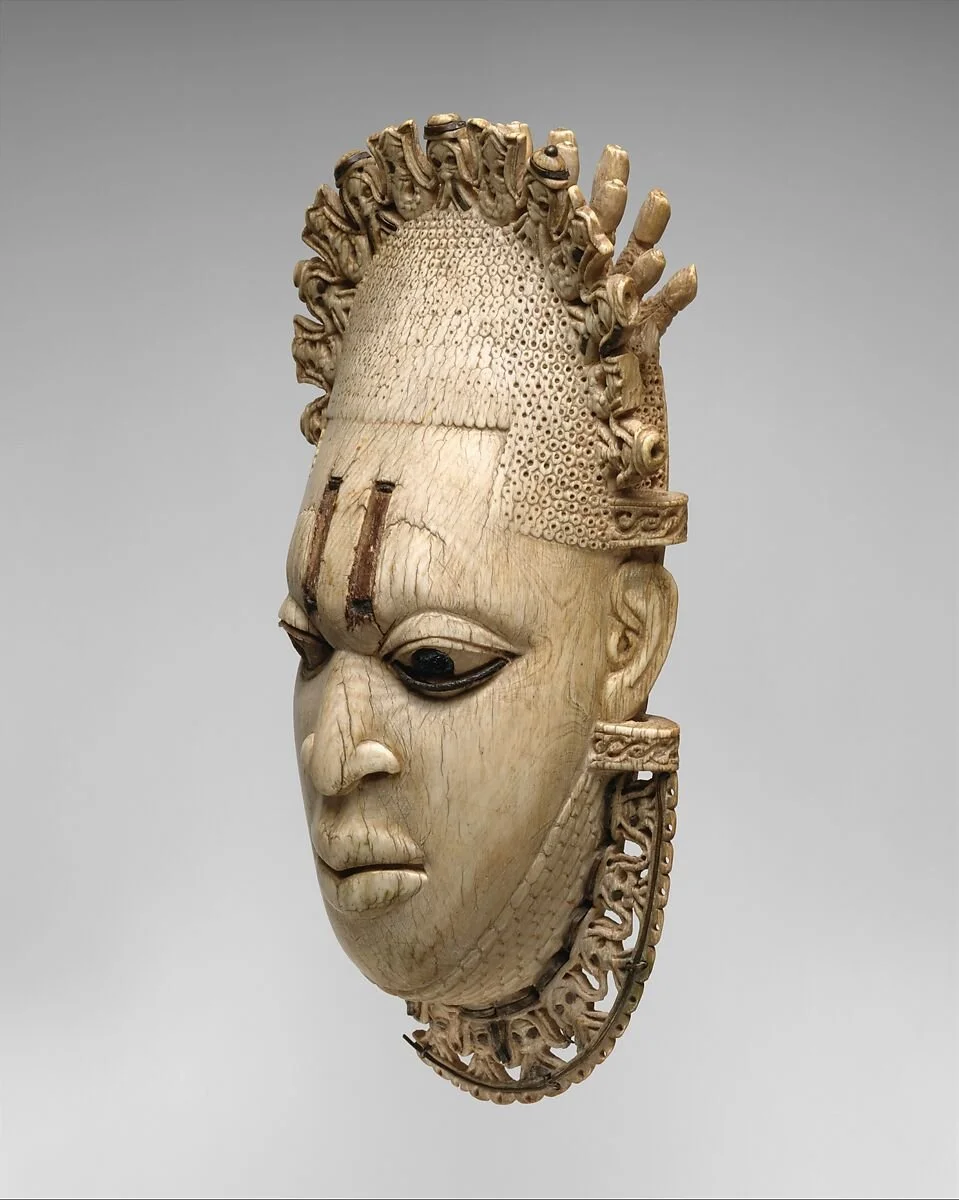
Three-quarters Profile of the Iyoba Idia Mask
Source: The Metropolitan Museum of Art
The masks take the form of a traditional African mask. The masks vary in appearance (the British Museum and Metropolitan Museum Masks are the most similar) but have similar characteristics.
The Iyoba’s face is serene and regal. She has iron inlay in her pupils and lower eye. Her face is symmetrical and pleasing to the eye. Her lips are slightly parted, perhaps showcasing her advisory role. Her face is natural and realistic.
She wears a headdress made of coral beads. She has a beaded choker surrounding her neck. Coral beads in the cylindrical style, or ileke, were meant for royalty only. The mask that has been returned to Nigeria has actual ileke strands of beaded coral wrapped around the forehead (see at bottom of article).
Her forehead has vertical cicatrices, or scars, where iron is inlayed to highlight the scarification. They refer to the story that she was scared by her parents on the advice of an Oracle who assured them that it would keep the Oba away. The Oba, Ozolua, allegedly saw Idia dance and wished to make her his wife. In the statue, the iron inlays are the representation of her metaphysical power as she denied the prophecy. The mask has four open loops on the side near the ear to allow for pendants to be attached so that the ivory can be hung as a pendant around the person.
Two of the ivories (in New York City and London) have a tiara. The mask in London just has Portuguese men while the New York City mask has Portuguese men and fish. The tiara has an openwork fringe design. Tiny heads of Portuguese men, most likely traders, are interspersed with mudfish. The Portuguese brought additional wealth to the Benin Kingdom through trade, the men symbolize the wealth of the Oba and his Kingdom. The men are identified as Portuguese traders through their long hair, their long mustaches, and their hats. The mudfish, or the West African lungfish, were a common detail in the arts of the Benin royal court. The mudfish can live on land and in the sea, and they symbolize the duality of the Oba, who is considered divine.

Detail of the Portuguese men and Lungfish from NYC’s mask.
Source: The Metropolitan Museum of Art via Wikipeida Commons
Her hair is detailed in coils featuring the hairstyle she originated, the ukpe-okhue or “parrot’s beak”. This type of hairstyle denoted her status, as common women could not wear this style. The hair would be adorned with coral in real life, denoting that a woman was crowned as royalty.
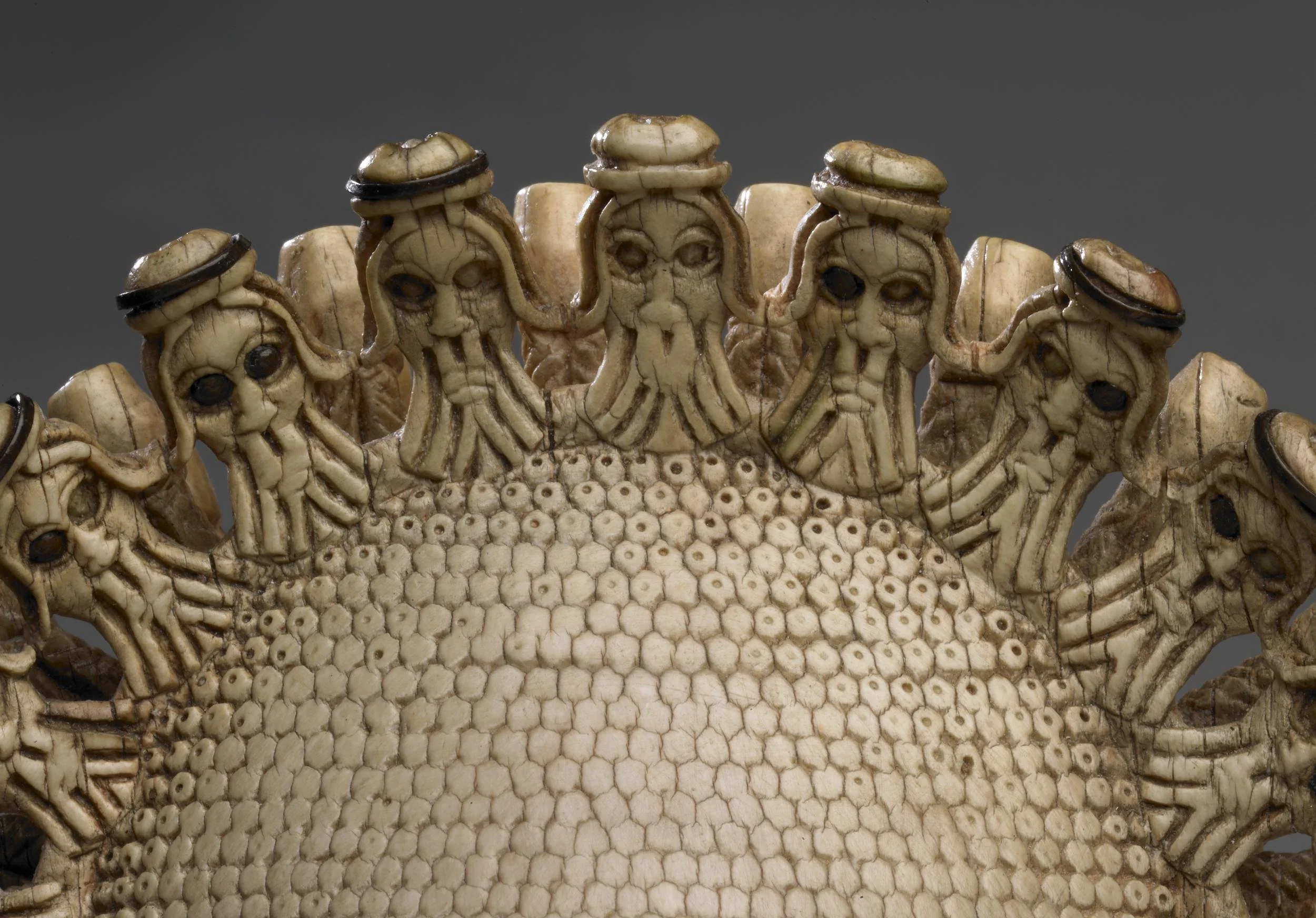
Detail of the hairwork and Tiara.
Source: The British Museum, Asset Number 522264001
© The Trustees of the British Museum. Shared under a Creative Commons Attribution-NonCommercial-ShareAlike 4.0 International (CC BY-NC-SA 4.0) licence.
Most of the ivory objects from the Igbesanmwan were created for the Oba to use during rituals and ceremonies. Perhaps these masks were also used in ceremonies to help the Benin people defeat evil spirits or to commemorate the Iyoba’s life. They were probably commissioned after the Iyoba’s death for placement in alters and to honor her achievements.
Due to the rarity of the women in early Benin art, the haunting visage of the mask, and use in Nigerian/African culture, the Iyoba mask has gained worldwide significance as an icon of African art. It might be the most famous visage in African art, and assuredly it is the most famous in Benin Art.
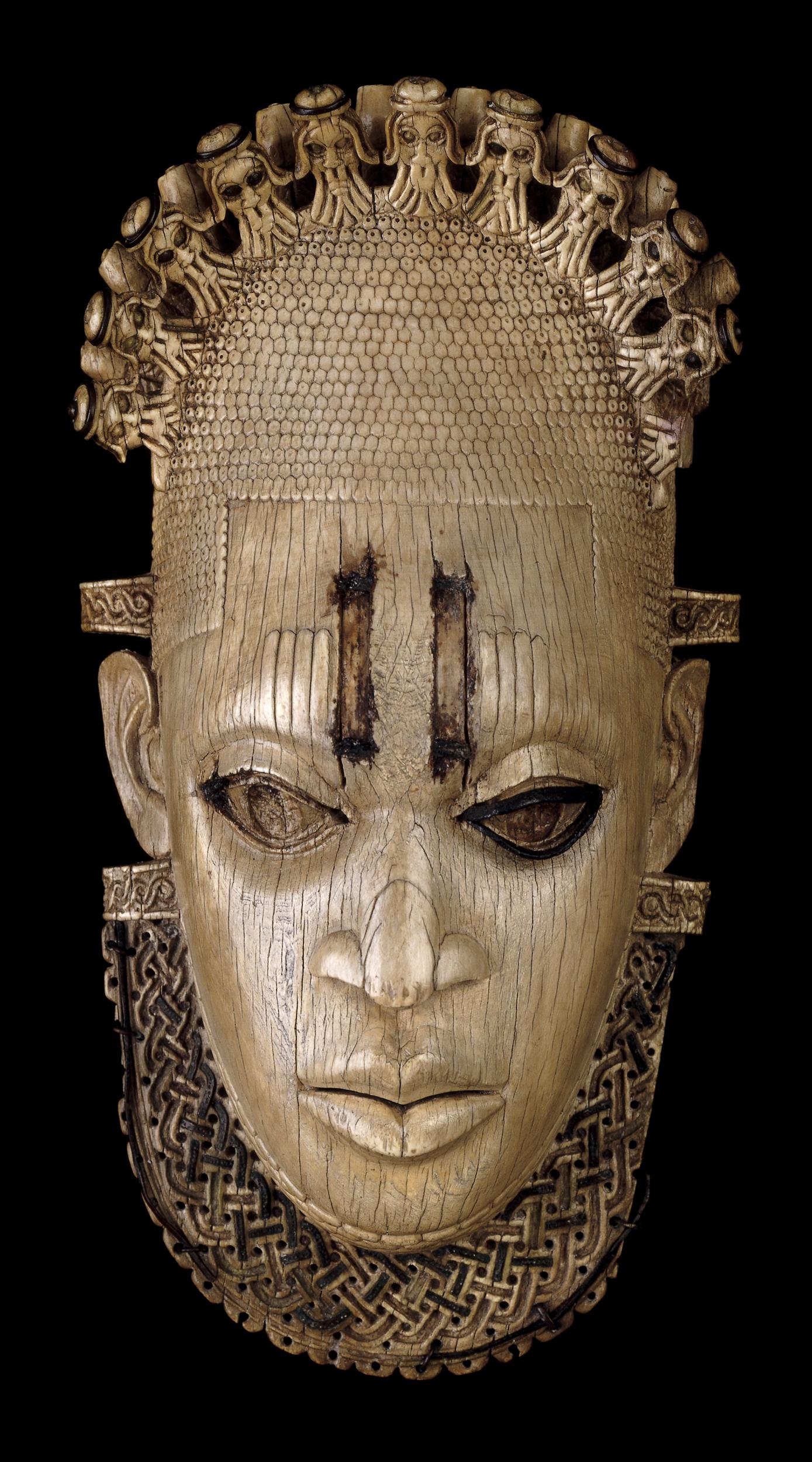
Iyoba Idia Mask
Source: The British Museum, Asset Number 34302001
© The Trustees of the British Museum. Shared under a Creative Commons Attribution-NonCommercial-ShareAlike 4.0 International (CC BY-NC-SA 4.0) licence.
Who is the Iyoba
The Iyoba is the Queen Mother of the Benin King, or Oba. The first Iyoba on record is Idia who saw her son reign the Benin Empire in the 16th century. The title was created specifically for her.
Previous mothers of the Oba were sent to their immediate death when their son became Oba as they were considered a threat to the power of their son. Oba Esigie wanted to keep his mother alive as she was thought to have mystical powers, so he kept her hidden while he worked to change the laws of the kingdom. Once that was done, Oba Esigie moved his mother to her own palace in modern day Benin City.
For her political advice and mystical help during Oba Esigie’s war with the northern Igala Kingdom (1515-1516), Oba Esigie titled his mother the Iyoba, or Queen Mother. This gave Idia a rarefied position in the society as well as a new role as the advisor to the King.
The Iyoba has a revered position in court, having raised the present Oba. She is given her own palace and money for artwork and royal lifestyle. Her position at court is equal to a senior advisor to the Oba. The Iyoba is chosen being the first of the Oba’s wives to give birth to a son. She will be acknowledged as Iyoba when her son becomes Oba.

A memorial bust of the Iyoba
Source: Ethnological Museum in Berlin, Germany via Wikipedia Commons
The Punitive Raid of 1897
The Portuguese arrived the Kingdom of Benin in 1485, at the beginning of the height of the Benin power. While the Portuguese were happy to trade with the Benin Kingdom under conditions set by the Oba, the British were not. The British Empire had moved into the coastal African era by the 19th century. They were interested in various oils and rubber resources and made official contact with the Kingdom in 1862. They offered to allow Benin to become a British protectorate, something the Oba had no interest in. Oba Ovonramwen had a monopoly on trade for the area and saw no need to comply with British terms.
In 1897, a diplomatic delegation of British men set forth to try and get a trade agreement with the Oba. It was during holy days in the Benin Empire and they were turned away. There has been thought that this was actually a reconnaissance mission as members of this delegation had asked the British Kingdom for permission to depose the Oba. Either way, soldiers for the Benin Kingdom saw this group as a dangerous coup attempt and decided to kill them. Only two men survived the massacre.
In response, Sir Harry Rawson led the Punitive Raid to capture the Oba of Benin, Ovonramwen Nogbaisi. The British force of 1,200 men burned the royal palace of the Oba and the royal palace of the Iyoba. The royal palaces were looted, with the British taking ivories, brass, and artworks. These pieces were brought back to England and then sold on to offset the cost of the raid. The masks were taken from the Oba’s bedroom in his palace. They had been kept in a large chest.
Oba Ovonramwen escaped from the British before returning to Benin City. The British exiled him to Calabar with two of his wives. He later died in 1914.
The British took over Benin City and incorporated the Benin Kingdom into African protectorate. The kingdom is now in modern day Nigeria. Oba Ovonramwen’s son took the throne as Eweka II. Oba Eweka II rebuilt the royal palaces and other offices of the Kingdom.
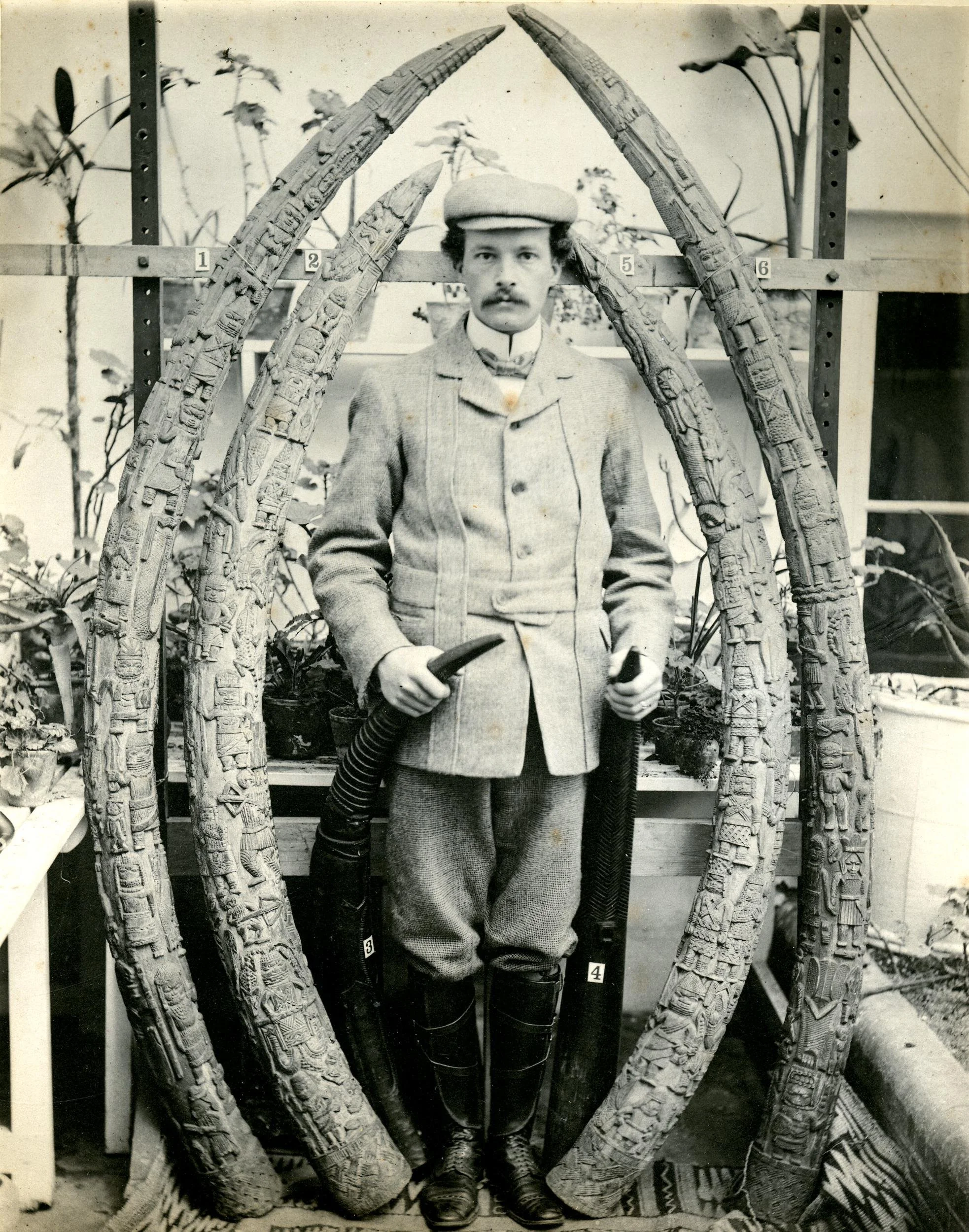
A man stands amongst some of the ivory taken from the Punitive Raid, thought to be photographed in London for an auction catalog for the dealer William Downing Webster.
Source: © The Trustees of the British Museum. Shared under a Creative Commons Attribution-NonCommercial-ShareAlike 4.0 International (CC BY-NC-SA 4.0) licence.
This image is asset number 1613871107 in the British Museum’s collection
Relocation and Current Locations of the Iyoba Masks
One mask is at the Metropolitan Museum of Art, one is at the Seattle Art Museum, one is at the British Museum. The Linden Museum in Germany had a bust but repatriated it to Nigeria in 2022. The last is in a private collection.
Charles Gabriel Seligman sold them to the British Museum in London in 1910. Two others were sold to the Stuttgart Museum and a private collector (Henry Galway). The Metropolitan Museum of Art acquired their mask through a donation from Nelson Rockefeller in 1972. Rockefeller had bought it at auction in the 1950s.
Oddly, African Art wasn’t collected as much by Europeans until the 1897 Benin Raid. The high quality of art made during the golden age of the Benin Kingdom entranced many who wanted to collect or own pieces of African Art - not just Benin’s output. The value of a Benin Bronze is now in the millions.
In 1977, FESTAC ‘77, the pan-African cultural festival was held in Lagos, Nigeria. FESTAC stands for the Festival of Arts and Culture. The festival decided to have a replica of the mask created to use as an emblem for the festival. The artist Erhabor Emokpae created the replica based off the version in the British Museum. FESTAC also asked Felix Idubor to create two versions for the national museum in Nigeria, which he did without being able to study the British Iyobe in perigon.
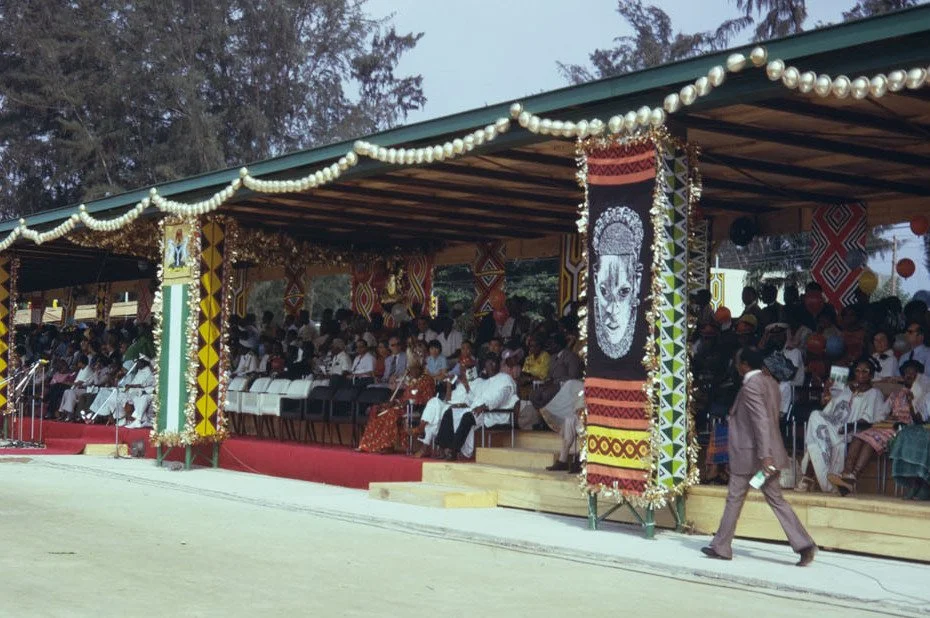
FESTAC ‘77. Note the banner on the right side with an image from the mask
Source: Wikipedia Commons
In March 2021, several museums in Germany and the United Kingdom returned some of the Benin Bronzes to Nigeria. The Nigerian Government, under the President Muhammadu Buhari, decided that the bronzes belonged to the Oba, and so they were returned to the royal palace. If the masks (or any other Benin Bronzes) are returned to Africa, they will also go to the Oba under this edict.
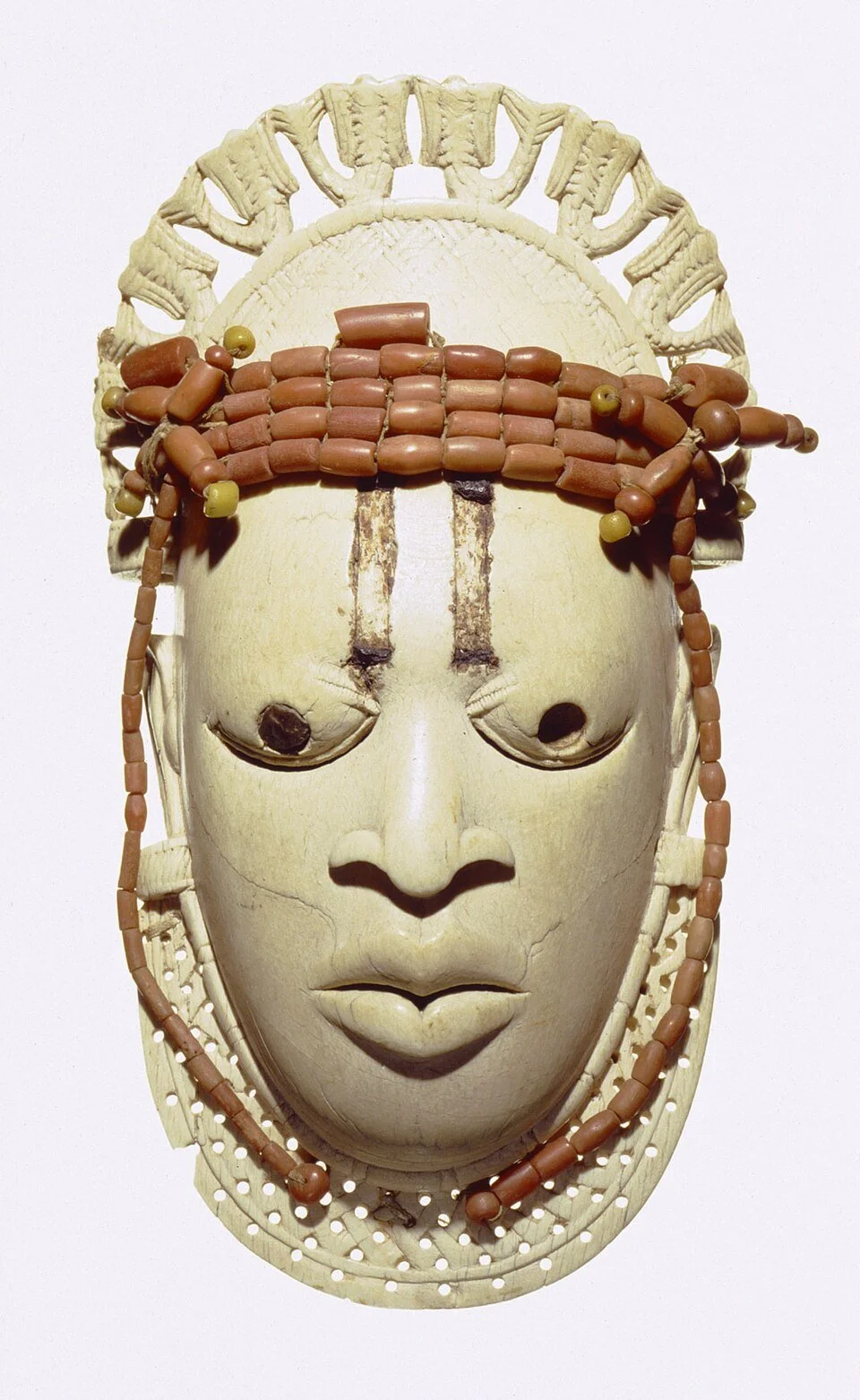
The Ivory Mask previously held by the Linden Museum in Stuttgart, now in Nigeria
Source: Wikipedia via Linden Museum
Works Cited:
Adebowale, Oludamola. “The Untold Tale Between Oba Esigie and Iyoba Idia of Benin.” The Guardian. 2019.
Amadi, Osa. “FESTAC at 40: The History and Mystery Behind the Mask.” Vanguard. 2017.
“Benin Bronzes.” Wikipedia.
Benin Ivory Mask. Wikipedia.
Bortolot, Alexander Ives. “Women Leaders in African History: Idia, First Queen Mother of Benin.” In Heilbrunn Timeline of Art History. New York: The Metropolitan Museum of Art, 2003.
Ezra, Kate. Royal Art of Benin: The Perls Collection in the New York Metropolitan Museum of Art. 1992. pp 41-42.
FESTAC ‘77. Wikipedia.
History of Queen Idia. ICOGA North America.
“Idia.” Wikipedia.
Ivory Mask. Google Arts and Culture.
“Kingdom of Benin.” Wikipedia.
Robinson, Alma. “The Controversial Mask of Benin.” The Washington Post. 1977.
Smith, Bonnie G. The Oxford Encyclopedia of Women in World History, Volume 1. pp. 527-528.


